
Table of contents
ㆍ2700+ programmatic SEO pages
ㆍOrg. traffic ↓by 56% vs 6 mo ago
ㆍ45% of total org. traffic
How does Clay use Programmatic SEO?
Clay is a CRM data platform. It gathers contacts from email, calendar, and social networks, updates your CRM with enriched profiles, tracks interactions, and recommends similar contacts to grow your network.
They use programmatic SEO or pSEO to scale content for pages like “How much did {firm} raise?” “Who is the CEO of {firm}?” and “List of {firm’s} executives & org chart” as their ICP likely search for this content to update their CRM and enrich existing contacts. Clay map these user needs and build their dossier pages programmatically to give insights into people, companies, and business data.
Go check their dossier, and you’ll see these pSEO dossier pages.
- URL: /dossier/{firm}-funding
- Title tag: How Much Did {firm} Raise? Funding & Key Investors | Clay
- H1: How Much Did {firm} Raise? Funding & Key Investors
- H2: What Is {firm}? How Much Funding Has {firm} Raised? What’s Next for {firm}?
How does this strategy impact their organic performance?
ORGANIC TRAFFIC
To analyse their organic performance only driven by their pSEO strategy, I only filtered the right URL path which is /dossier. Here we go – organic traffic trending upwards up until October 2025, followed by a sharp downtrend.
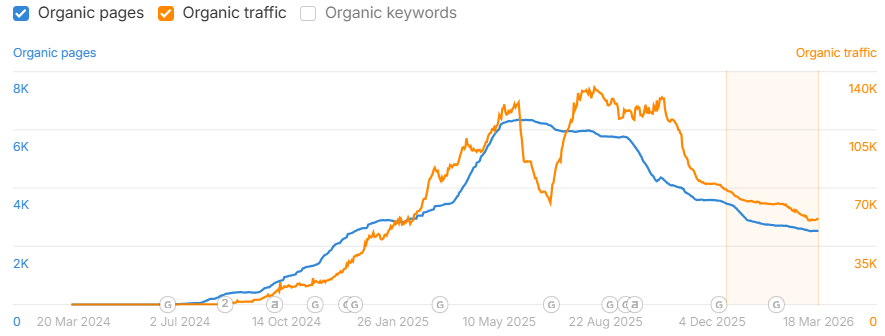
Sept 2024: 3,180 traffic with 796 org. pages
Mar 2025: 79,337 traffic with 3,959 org. pages (24.9x; 5x vs 6 months ago)
Sept 2025: 115,664 traffic with 6,014 org. pages (↑46%; ↑52% vs 6 months ago)
Mar 2026: 51,315 traffic with 2,772 org. pages (↓56%; ↓54% vs 6 months ago)
As of March 2026, their pSEO pages represent 45% of their total organic traffic. The significant drop in organic traffic from these pages directly affects their total organic traffic, which has dropped 39% vs 6 months ago.
Looking at both organic pages and traffic, the trend has been consistently downward. Clay has also pruned a portion of its pSEO pages, likely recognising that the dossier content was off-brand (i.e. a CRM data platform V.S. content on the HQ office, funding and Executive info), leading to potential penalty by Google. Many SEO professionals also argued the short-term benefit vs long-term sustainability on pSEO content if not handled cautiously.
In addition, I doubt their strategy has driven much meaningful business impact, as it appears they’ve deprioritised this strategy, with the last batch of pages published in Q2 2025.
ORGANIC KEYWORDS
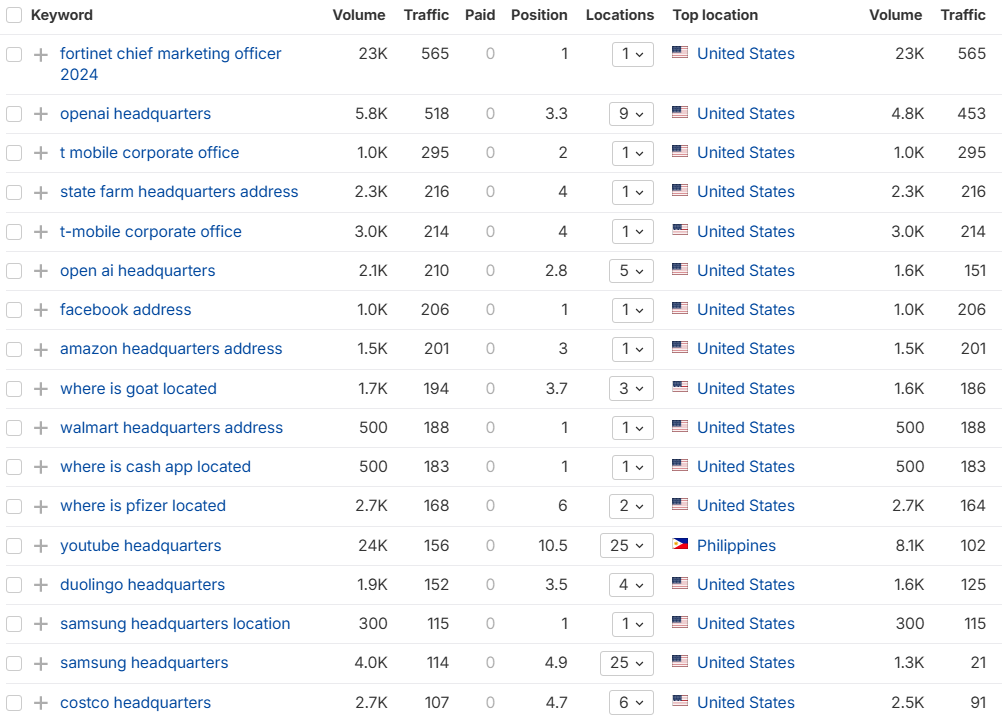
Looking at the organic keywords they are ranking – the templated pages are ranking for over 12,000 keywords matching the purposes of these pages.
What do I like and not like about their strategy?
LIKES
✔️ They use programmatic SEO to scale user-centric content.
✔️ They actively refresh and prune their pSEO pages, keeping what performs and removing what doesn’t.
✔️ Their content is tightly connected to the product by using an interactive demo to show how Clay gathers or enriches funding and business data at the bottom of the page. (Content: providing business/funding data users are searching for <–> Product: automatically gathering this data and updating your CRM)
✔️ Unlike typical pSEO pages that feel 90% identical, Clay’s content includes meaningful differentiation, making each page feel more useful and less templated.
DISLIKES
X While I agree these content pieces were created based on what their ICP is actually searching for, there could be many different intents for a user searching for that.
X Clay is a CRM data platform while this type of content is around “funding”, “office location” and “executive list”. This “producing lots of content beyond the core entity” strategy may go against Google’s helpful content guidelines, especially since they represent over 70% of all pages.
X Their dossier is like a content dump without clear navigation or search functionality to help surface content.
