
Table of contents
AI search is reshaping how people find information online. Unlike traditional search engines that return a list of blue links, AI search synthesizes answers directly from web content, citing sources inline. Understanding how it works is now essential for any SEO professional.
Why care about AI Search optimization?
These are emerging platforms that users are active on every day, helping us discover content and learn much quicker than traditional search. A Webflow case study even showed LLM traffic converts way better – 6x higher conversion rate vs Google traffic. It’s likely because users are more “qualified” after a conversation
Now your turn, what’s your traffic and conversion like from LLMs?
Before jumping into LLM optimization strategies, it’s good to see where you stand. First, this can be your baseline to evaluate if your future efforts bring in impacts. Second, if a decent amount of traffic and leads come from LLMs, it’ll be easier to get more resources and budget to scale this emerging “growth” channel.
Traffic coming from LLMs:
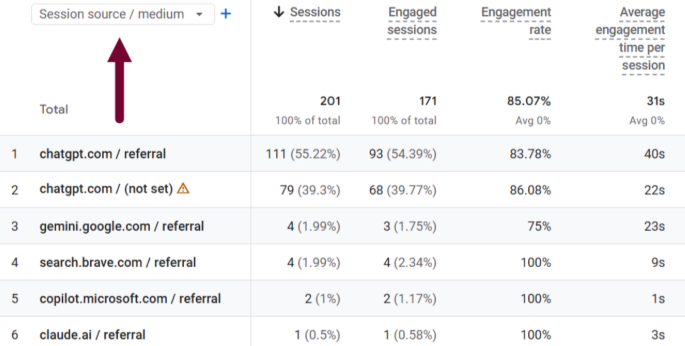
You can find this data from Google Analytics 4 (GA4): Start by clicking ‘Reports’ > ‘Acquisition’ > ‘Traffic Acquisition.’ Then, change the ‘Dimension’ to ‘Session source/medium’. Now, look for ‘ChatGPT‘, ‘Gemini‘, ‘Copilot‘, etc
Leads coming from LLMs:
If you have key events like demo form fills and newsletter subscription set up already in GA4, you can see the number of key event counts in the same report. However, this approach neglects the LLM-influenced events, e.g., a common occasion where a prospect initially discovers your brand in ChatGPT, then opens a new browser to Google your brand. This type of indirect event is not categorized as LLM referral traffic, but organic.
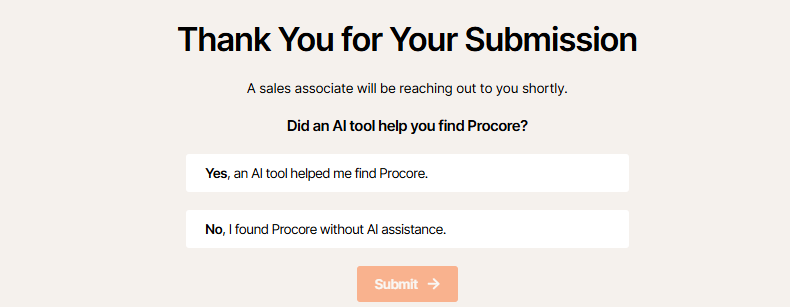
In this case, we can be a bit more creative. When I was working for Procore, we added a question after a prospect submits the demo form to see if LLMs helped them discover our brand. (This way didn’t affect the demo request process.) We saw 20% said yes, which was a baseline to measure against our LLM optimization efforts.
LLM optimization strategies
- Focus on your foundational SEO
- Get brand mentions outside your website
- Make sure your positioning and messaging are consistent and updated across the board
- Analyze any obvious pattern of AI bots visiting your content
- Optimize your structure for easy extraction
1. Focus on foundational SEO
AI search optimization is basically SEO.
There are two main ways your brand can appear in LLM outputs:
(1) indirectly through training data, which shapes how the model behaves in answers but doesn’t produce attribution or citations, and
(2) directly through retrieval (via pre-fetched web data collected by searchbot like OAI-Search bot, Search API and/or live fetching by e.g. ChatGPT-User). The content retrieved from one or more sources is processed and injected into a RAG context, where it’s combined with the LLM’s reasoning to generate the final response in chat.
That’s why when we say AI search optimization is basically SEO, we are referring to the latter (2). If you want to increase the chance of appearing in LLMs, make sure to become visible organically in search.
Nick Turley, Head of ChatGPT at OpenAI, told The Verge:
“I still believe that, no question, the right product is LLMs connected to ground truth, and that’s why we brought search to ChatGPT and I think that makes a huge difference.”
This reinforces the idea that SEO has become even more important.
How do we do this? That’s foundational SEO – on-page, off-page, and technical SEO, like how you used to improve SEO pre-AI era.
2. Get brand mentions outside your website
Again, your brand is more likely to appear in LLM outputs when it consistently shows up in search results across both your own site and third-party websites. It increases the chances that it gets retrieved and mentioned for relevant prompts.
How do we do this? Invest in digital PRs, link building and partnerships. I understand these channels can be challenging if you don’t get enough resources and budget, then work on Reddit, which is one of the most cited domains. You can set up alerts for your brand and related terms, and engage in real conversations as they happen.
3. Make sure your positioning and messaging are consistent and updated across the board
Consistency matters because retrieval systems pull from multiple sources. When your positioning is aligned across the web, the same themes and associations show up repeatedly. That makes it easier for systems to recognize what you do and when to mention you.
How do we do this? Regularly audit your brand messaging everywhere. The best practice is to compile a list of your social platforms, review platforms, and any directories that you signed up for, also not to forget to check those that are automatically created by third parties regularly.
4. Analyze any obvious pattern of AI bots visiting your content
You want to understand how AI systems are actually interacting with your site, not just assume they are. Tools like server logs can help you spot traffic from known LLM crawlers (or sudden spikes in unusual page depth patterns). This gives you a sense of what content is being surfaced, what’s being ignored, and whether bots are favoring certain content formats or pages.
How do we do this? Start by reviewing log files for bot traffic patterns, then segment by landing pages, depth, and repeat visits. Over time, you can identify which content types are being consistently accessed and double down on those structures.
5. Optimize your structure for easy extraction
When an LLM system retrieves a live page, it doesn’t “read” it the way humans do. It fetches HTML, ignores the noise, breaks text into small bits and selects the useful ones. That means clarity, structure, and semantic hierarchy matter more than ever. If your content is buried, vague, or overly complex, it’s harder for the system to extract your content.
How do we do this? Use clear headings (H1 > H2 > H3) that map directly to questions, keep paragraphs tight and self-contained, and make sure each section can stand alone without needing extra context. Think in “answer blocks” rather than long narrative flow. Add structured elements like lists, FAQs, and schema where relevant, and make sure your content directly mirrors how users actually phrase queries. Also, keep the core content in the initial HTML.
FAQs about AI search
For queries like “What is the capital of Japan?”, ChatGPT likely taps into the pre-trained knowledge (GPTbot crawls public data for data training purposes) and generates a response directly since the query is simple, factual and the training data is good enough. If you ask “the best three recent movies”, the system may need to use different methods to retrieve up-to-date, fresh data to fulfill this query. Methods to retrieve data:
- Internal: ChatGPT-User retrieves the pre-fetched web data collected by the OAI-search bot, stored in the internal index. [Note: this is not the training data]
- External: The system calls the Search API (like Google or Bing) to get a list of URLs, metadata, snippets, etc. After ranking and filtering, it selects the most appropriate ones for the query. If the metadata or snippets from the selected ones are enough to answer the query, then they may be used and no live fetching is required. If not, ChatGPT-User may need to do live browsing from the selected pages to extract content as a follow-up step.
The system may heavily use one source or both together to extract data. Finally, the extracted data from one or more sources will feed into RAG to answer this query in chat.
