
Table of contents
ㆍ950+ programmatic SEO pages
ㆍOrg. traffic ↓by 45% vs 3 mo ago
ㆍ31% of total org. traffic
How does Favikon use Programmatic SEO?
Favikon is an AI-powered SaaS platform for influencer marketing that helps brands and agencies discover, analyze, and manage influencers across multiple social platforms.
They use programmatic SEO (or pSEO) to scale content for their {top influencers} pages, e.g. “Top 10 Indian YouTubers” and “Top 10 Twitch Streamers” as their ICP likely search for this content to analyse and reach out to these influencers. Favikon maps these users’ needs and builds their {top influencers} pages programmatically to answer their users’ intent.
Go check their top influencer hub, and you’ll see these pSEO pages.
- URL: /blog/top-{niche/country}
- Title tag: Top {niche/country + year} [🏆Rating] – Favikon
- H1: Top {niche/country + year}
- H2: Here’s the list of the Top {niche/country + year}:
How does this strategy impact their organic performance?
ORGANIC TRAFFIC
To analyze their organic performance only driven by their pSEO strategy, I only filtered the right URL path which is /blog-top-. Here we go – organic traffic trending upwards up until October 2025, followed by a sharp downtrend.
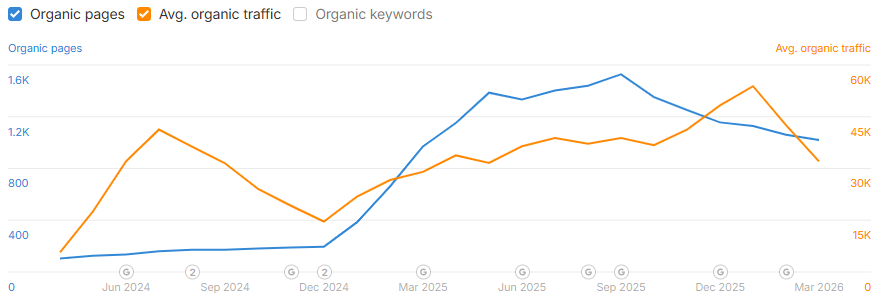
Sept 2024: 31,510 traffic with 172 org. pages
Mar 2025: 29,021 traffic with 971 org. pages (-8%; 5.6x vs 6 months ago)
Sept 2025: 38,807 traffic with 1,528 org. pages (↑34%; ↑57% vs 6 months ago)
Mar 2026: 32,081 traffic with 1,020 org. pages (↓17%; ↓33% vs 6 months ago)
As of March 2026, their pSEO pages represent 31% of their total organic traffic. The drop in organic traffic from these pages directly affects their total organic traffic, which has dropped 48% vs 6 months ago.
Looking at both organic pages and traffic, the trend has been going downward. The reason for the decreasing number of pages is not because Favikon has pruned their content, but Google de-prioritises their pSEO pages. Many SEO professionals argued the short-term benefit vs long-term sustainability on pSEO content if not handled cautiously. It’s worth noting that while the traffic drop may seem like a failure to some, we can’t ignore that their programmatic efforts have driven 32k in solid, BOFU traffic.
They are still producing this type of content continuously. I’ll be curious to find out how Google treats their programmatic SEO in the long run. Will come back and update my post.
ORGANIC KEYWORDS
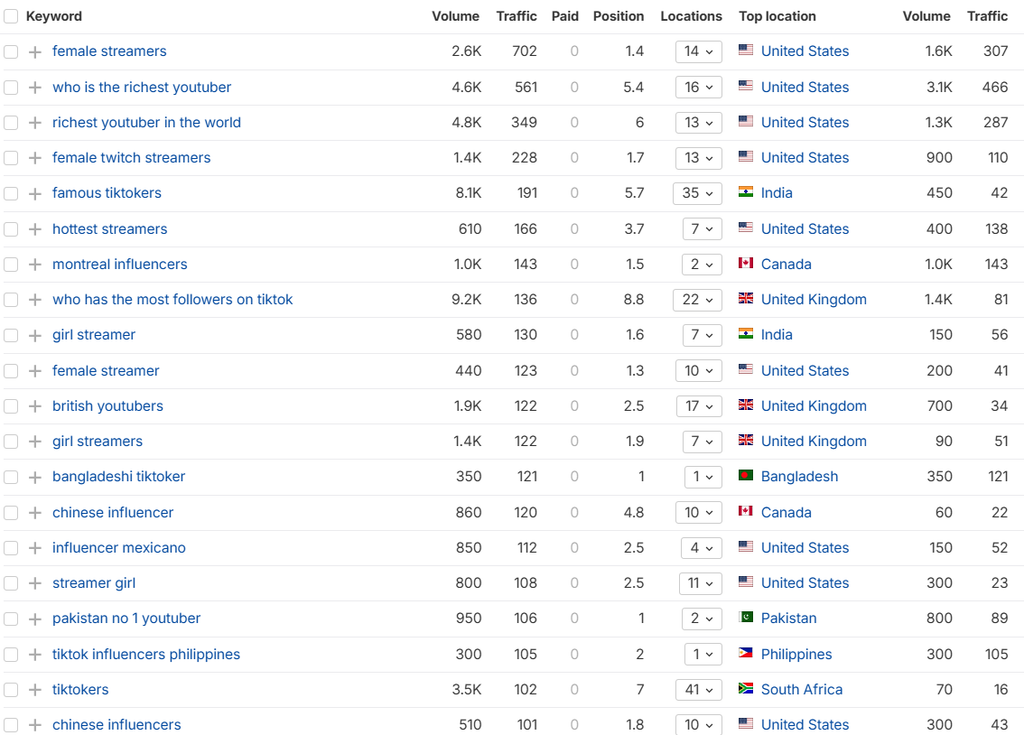
Looking at the organic keywords they are ranking – the templated pages are ranking for over 6,000 keywords matching the purposes of these pages.
What do I like and not like about their strategy?
LIKES
✔️ They use programmatic SEO to scale user-centric content.
✔️ They optimize for E-E-A-T by showing who wrote the content and the person’s qualifications
✔️ Their influencer category page offers good navigation to search for content very easily
✔️ Their content is tightly connected to the product by linking to the product interface to learn more about each influencer. (Content: providing high-level data for the influencers users are searching for <–> Product: showing a comprehensive overview of each influencer and their follower base for users to analyse)
✔️ Unlike typical pSEO pages that feel 90% identical, Favikon’s content includes meaningful differentiation, making each page feel more useful.
DISLIKES
X While I agree these content pieces were created based on what their ICP is actually searching for, there could be many different intents for a user searching for that.
X Favikon can add more helpful stats that their ICP likes, such as engagement rates and follower insights, to their pSEO pages instead of only the number of followers.
